Basement Flooring Options When Remodeling

Google Advertising
Basement remodeling is an immensely popular project that thousands of homeowners decide to undertake every year. A well-planned and finished basement can be put to many practical uses that vary from being just a guestroom of the visitors to a complete entertainment room.

Choosing basement flooring for any part of the house is quite a tricky affair, all the more so for basements. The reason is not far to guess, as we all are aware that basements are typically prone to attracting moisture from the atmosphere. That somewhat imposes limitations on the choice of flooring for the basement.


Any basement remodeling project would necessarily involve some means of getting rid of the most of the moisture therein. Here is a very simple test to assess the moisture content in you basement floor. Take some non porous material, like a black trash bag and seal it using an adhesive tape around a couple of different points on the floor of the basement. Let it remain there for 24 hours and then check underneath the material. If you notice any condensation of water vapors, it means your basement needs to be treated for getting rid of the moisture.

Having taken measures for making the basement dry and on finding the results satisfactory it’s time to look for an appropriate flooring material for your basement. Here are some of the more popular options, helping you to choose one.

Engineered Hardwood Flooring – Here is a modern material that can better withstand moisture than the conventional hardwood flooring. Being thinner than the natural hardwood, it allows for installation of additional insulating material, which in most vases is desirable, if not essentially needed.

Laminate Flooring – For a moderately dry basement, laminate is the best way to get the looks of hardwood without spending a lot of money. However, some laminates are not so well suited for floors that have even a little bit of extra humidity. You would do well consulting a flooring specialist to know the right laminate before investing into one, for a damaged hardwood flooring is beyond economical repairs.

Ceramic Tile – In their case the subfloor needs to be just dry enough for holding on to the adhesive. So, you have to pay some extra attention while the subfloor is being prepared.


Flooring Options that may not work well – Considering the expense and the likely risk associated don’t make it worthwhile to install low grade of hardwood floor. Engineered hardwood is definitely a better material for floors below ground level and the results are very satisfactory and beautiful.

Even carpets in the basement may be risky. You should understand that even a basement that you might consider dry is sure to have more moisture content than the rest of the house. It’s a natural phenomenon that can’t be helped beyond a point. Having a carpet over the entire basement is an invitation to mold and mildew that ultimately is sure to ruin the carpet. But, you may still have the comfort of using a carpet there by incorporating a couple of well positioned area rugs.

Carpeting Basement Floors And Taking Care Of Mold

Google Advertising
I have my office in the basement of my home. That allows me to have large space of around 700 square feet to work in with all the needed furniture, not only for self but for the visitors too. There is a large desk that includes a TV and all the electronic paraphernalia that you’ll find in any corporate office.

Moisture is a problem therein, not that it ever got flooded. My basement can be treated as dry. But being below the ground level, it attracts moisture. It’s my dehumidifier that makes me realize of its presence - it gets filled up twice a month in winters and now and then once a day when the humidity rises.

Carpeting Basement Floors

I often wonder if my carpet would remain as dry in the absence of a dehumidifier! Would my carpet get sprayed with water? And what happens to the volume of water that the machine is unable to collect for whatever reasons?

Moisture can enter even new constructions despite the provision of a moisture vapor barrier. A French drain around the house or the gutter system could be the cause of it. And, let it be known that moisture leads to mold.

As one can’t see mold around or feel it in the air that one breathes, you are left wondering what’s so bad about mold!

I'm not an expert but I conducted a bit of research on the subject of mold. Mold has tiny spores, with hundreds of thousands of them capable of fitting on the head of a pin. They can penetrate thru our immune system to enter into our lungs. On entering the lungs they can get in our bloodstream and oxygen and may permanently scar lung tissue. Some of the common symptoms are: colds, fatigue, headaches, dizziness, and shortness of breath among others.

Fortunately I enjoy good health, yet I can feel it at the end of a day’s work in my basement office.

One way out is carpeting basement floors with area rugs. Applying concrete stains or having sealed decorative concrete floor coatings helps to contain mold. Maintenance of sealed concrete becomes easy and helps preventing building up of mold.


One big benefit of having area rugs is that they keep the basement warm and are conveniently rolled up for being sent to the cleaner. They are conveniently replaced or removed. But, the slight limitation is that you can’t have light easily moveable furniture on the rugs. That’s because frequent movement of furniture adversely affects the life of rugs.

It’s comfortable walking on a wall to wall carpeting. But, it’s frequently glued down on the floor, meaning you wouldn’t like to have it replaced too soon, especially with all the tastefully bought furniture for your office cum home. That’s because it’s quite a task to get them unglued and the subsequent removal of dried gum from cement floor is a tough job indeed. Did you notice that wall to wall carpets have tack strips that have been hammered down along its edges? As you remove them, the holes get exposed and need to be suitably filled up using filler.

Here’s a tip for you if you plan to use your basement more often. Rather than having wall to wall carpeting or even area rugs, you would be better off with a decorative concrete coating!

Basement Floor Paint - Choose The Right One

Google Advertising
While remodeling your basement, application of the right kind of basement floor paint is of prime importance. You wouldn’t like to apply some paint that is too hard to clean or wears off too soon. That’s what makes it so important to choose the right material for applying on these floors.

The best known paints for such applications are known as epoxy based paints or simply epoxies. Though primarily developed for industrial application due rough and tearing circumstances over there, they were eventually found ideal for certain domestic application, like basement or garage flooring.

Basement Floor Paint

Epoxy paints are extremely durable and highly resistant to chemicals like oil and grease. That in effect makes them ideal for use in garages or the porches.

Additionally, these are waterproof, and we all know how prone the basements are to humidity and the accompanied dampness. These epoxies are known to raise the heat resistant characteristics of paints.

On the whole, these paints don’t need much maintenance. They offer easy application and are highly durable, the reasons that they were found highly desirable for industrial applications.

The most durable basement floor paints are the most expensive too and are cent percent solid pints, followed by 40-60-percent solids. Because of the price and the durability features these are primarily found desirable for industrial uses, making them rather unviable, as far as economy goes, for domestic applications.

The type of epoxies used for domestic purposes are water based and much more economical to use. Moreover, these are conveniently available at most hardware stores

And, for the convenience of homeowners these are available in very many colors. That’s an important consideration not to be ignored if you plan to use them, as you certainly would want the color to go along the rest of your cooler scheme that’s already there in the basement or the intended room.

Application of these paints is not really difficult. The only thing you need to ensure before applying such paint is that the surface be prepared by thorough cleaning so that there is no dust.

In short you have to take care that there are no imperfections on the floor before application of such paints. The ultimate quality of output largely depends on how well you prepared the floor. Another factor is the purpose for which you intend using your basement. If it is gong to work as a storehouse for all the household junk, it doesn’t really matter how well you prepared the floor.

It is important to carefully plan and purchase your paint. Keep the area of the room and its functionality in mind, and even what you might like do with this room in the not too distant future. If you are the type who likes to have frequent changes of color or décor of the room, choose your paints accordingly.

Using concrete sealer gives a better finishing touch to your basement floor, in terms of looks, as well durability. Isn’t it nice that epoxy kits and the connected hardware needed for their application are available at most hardware stores!

The Cost Of Laminate Flooring

Google Advertising
I've got few emails about my last post so I decided to write a bit more about laminate flooring for basement. Since you guys wanted to know how much will this kind of flooring cost you, here is another long post for you all. I hope it will help you determine the real value of basement laminate flooring so you can install one in your own home. Enjoy!

The cost of installing laminate flooring for an average-sized basement of about 100 square feet varies from $600 to $ 1500 and would largely depend upon the kind of laminate flooring you decide to have in your basement. The wide variation in price is due type of laminate flooring that may be glued laminates or glue-less variety or a floating flooring. Further, depending on the kind of flooring, you need many different tools for an installation of the same.

A helpful feature of floating laminate floors is that it doesn’t require many tolls and the installation is rather easy. On the other hand, glue less laminate floors or the glued laminate floors necessitate the use of many tools for getting the flooring right. In any case you have to prepare your floor before you proceed with the installation of a laminate floor. the list of tools for the purpose includes a pry bar for removing and trimming the shoe molding, a level to check that the floor is evenly leveled, a cold chisel to pull out the cold flooring and a ball-pen hammer to hit the chisel. You’ll also need a putty knife for preparation work and a floor scraper for removing all the residue from the floor.


In case you have a wood sub-floor, a belt sander will be required to smoothen the surface. You could require a jamb saw for cutting the doorjamb or other trimmings to get the clearance needed for the flooring. But, you need not necessarily buy a jamb saw, and hire one for the purpose. Then, you need a trowel to smooth the leveling compound. All these tools along with a rented saw will amount to about $100.

You’ll need additional tools for the installation of the basement laminate flooring. These tools are a backsaw and a miter box, needed for making angular cuttings on the floor. You make straight cuts with a circular saw that has a carbide blade; while curves are achieved by using a saber saw that has a laminate blade. You really don’t have to buy these. Instead, hire these from your local hardware store. Normal rent for these will be in the range of $20-30 a day. The basic tools needed for the installation of laminate flooring in the basement will be around $100.

You will require coping saw, hacksaw, utility knife, screw clamp, straps, pull bar, driver, electric drill, tape measure, marker, caulking gun, a tapping block, claw hammer, clamp, and nails. The long list of needed items need not upset you as you also get laminate floor installation kits. The kit contains all the tools you will need to complete the job. Its price varies from $350 to $500 and saves you a lot of time in collecting each and every item. The kit may work out to be slightly more expensive than if you bought the items individually.

If you intend installing glued laminate flooring, you will need to have glue also. While you consider having laminate flooring in the basement you should use glue even with glue-less laminate flooring. This goes to provide extra sealant in areas that tend to remain humid or attract moisture, for example areas beneath the dishwasher or the refrigerator.
The additional protection provided by glue and sealant gives additional life to your floor, making them last longer. The cost of glue and sealant for the basement will be around $40, whereas the cost of laminate flooring varies from $0.65 to$3.0 per square foot, depending upon the kind of flooring you opt for. The total expense for an average-sized basement of about 100 square feet may vary from $100 to $600. It all depends upon the kind of flooring, whether you like to go for glue-less planks or the glued laminate flooring. The quality of the laminate and the protection provided to it makes all the difference in costing.

Laminate flooring also needs to have an underlay. That comes in the form of rolls of 100 square feet. Its average price is about $0.30 per square foot or $30 for a roll of 100 square feet. When buying the underlay or the laminate itself, you should buy a little more than the actual measurements of the basement. That extra length will take care f the errors that one makes while installing the floors. Depending on the actual size of your basement and the kind of flooring that you decide to have for your basement the project cost for installing laminate flooring in your basement may vary from $600 to $1500. Of course, you have that choice of buying the tools separately or buy a complete kit.

As you know the basement area tends to have mold around the sink, refrigerator, dishwasher, as all these appliances are associated with water in some form the other.
Therefore it would be worthwhile to provide more protection to the flooring there, else you might have make recurring expenses for its maintenance. For the same reason, you should consider having better quality laminate flooring for the basement.

Installing Laminate Basement Floor

Google Advertising
If you are ready to take care of the following five important steps and precautions, you’ll surely get a successful installation of a laminate floor without causing any harm to yourself or the new floor you intend installing.

1. Generally most of the manufacturers of laminates give warranty for its being installed below grade. Now, that is unlike a hardwood floor. Yet, it will be good to check the warranty clause as provided by re manufacturer.

2. Like any other flooring, laminate flooring too takes its time to get acclimatized to the surroundings of a new place. The best way to achieve that would be to store the intended flooring for about a week before you actually start its installation.

3. It is important to leave room for expansion of laminate. You would certainly be required to keep a gap of half an inch all around the perimeter of your room.

4. You have to be absolutely sure that the basement is totally dry. Remember that humidity and water is enemy number one for subfloors. You should save yourself from the uncalled for financial and physical strain of redoing the job by being cautious before hand.

5. Last, but the most important precaution that you should never afford to overlook concerns your personal safety. Put on your safety gear, particularly goggles, while handling any of the power tools for doing any job.

As laminate flooring is not nailed down it is essentially a floating floor. That makes its installation very convenient. An added advantage is that it has the pleasant appearance of a hardwood floor.

laminate basement flooring

It is quite an interesting and easy to execute DIY project. Here’s how it goes.

1. Before you really get down to the task of laying a laminate flooring it will be helpful to read on the topic of preparation of basement flooring. First step is to cove the entire floor with the subfloor, vapor barrier and padding. Generally vapor barrier and padding form a part of the purchase of the laminate flooring.

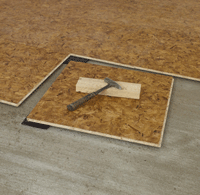
2. Having done that, you are ready to start the installation. Using the tongue and grove technique connect a number of planks together to form a long row. Take some another piece of wood lying around the house and put the laminate in place by slightly tapping it. You may need to use this piece of wood for attaching each piece into the groove by slight tapping. The more the number of planks you fix, the sturdier the floor gets.

3. As the number of rows increases, you should continue to stagger the seams. This imparts additional strength to floor in the absence of any clear break line.

4. In due course you will be required to cut the planks to fit with the walls. Take measurement of the space between the wall and the installed board and cut accordingly. You can very easily cut these planks by using a table saw, which is sturdy and thus safer to use than a hand-held circular saw for such kinds of jobs. Alternatively, you may even use a pry bar, a shorter version of a crow bar or caw-caw. Don’t you worry about that, it’s very easy and needs no technical talents.

5. For having a snug fitting around irregular areas like corners or immovable round poles, use a jig saw to get the desired perfect shapes.

6. Continue laying the planks, one after the other till the entire basement floor is covered.

7. Having laid the basement flooring, just install some trim/base boards on the top surface and your finished basement floor is ready.

Basement Tile Floor Tips

Google Advertising
To bring about a different and inviting look to your basement floor, you'll need to make a big effort. But, the advantage of getting additional floor space that can be put to better use is inviting enough to make it a worthwhile venture. End of the day you feel happy of achieved what you set out to do. Be it a concrete or a wooden floor, you need to condition it to look more inviting and neat while it offers durability and the ease of cleaning. Once you have achieved that, rest of the furnishing is not as difficult. Tiles offer a good medium for redoing your present floors. Here are some of the noteworthy points for having a tiled floor.

1. Compared to other kinds of flooring materials, a tile floor is not as expensive. You may choose to have a peel-and-stick variety. It comes in different designs and is so easy to fix that you won’t need an expert for getting the needful done. Now, that is a big saving. Apart from its being economical there’s another very helpful feature of this type of flooring. There is no compulsion for you to finish the complete floor in one go. You may conveniently spread over the project to a couple of days or seek the help of a friend or another member of the family for a speedier completion of the project. Depending on your budget and the intended purpose of readied floor, you may opt for an expensive design and style to get an even richer look.

2. Tiles offer the ease and convenience of replacements. If any piece gets stained or damaged for whatever reasons, you could always replace that with a new one. Since it is do- it- yourself kind of a project you are not depending on the services of any third party who may not be easily available at your convenience.

3. Tile floor is cleaned easily. Let your child invite all friends for a party without your having any anxiety of the floor getting spoiled by spill-over of coffee or other beverages. Likewise, muddy shoes too pose no problems or the footmarks of your pet. Simply fill a bucket of hot water with a few drops of mild detergent as recommended by the manufacturer, and mop up all the dust debris or dirt in a matter of a few minutes.

4. The ease with which a tile can be changed or replaced has another advantage than mentioned already. One fine day you feel rich enough to have wall to wall flooring. The change over from tiles to a carpet involves no technicalities. The switch over is fast and easy. Very often people just lay the carpet over and above the tiles without even removing the tiles. That makes it so convenient!

5. Look at the versatility of designs of tiles. You may have a primary monotone color shade that blends with the neutral surroundings. Or go for an ultra mod design that transforms your basement to a recreation room for the family. May be you like to have a cool and decorative pattern on the floor and convert the basement to a more personal den or utilize the space for an extra bedroom. Add a couple of rugs around the place and create your personal desired scenario.


Basement tile floors are characteristic of bearing rough treatment from shoe traffic, and foot falls of pets and growing children. Easy availability of tiles in attractive colors and designs is encouraging for any householder to brighten any basement for its being put to a worthwhile use.

Bamboo Flooring Installation For Basement

Google Advertising
The application of technology to bio products has been successful in bringing around some very useful properties to some of the most conventional materials used for building houses. Bamboo flooring is one such development that has improved the quality of bamboo used for such applications.

While giving beautiful natural look to the floors, bamboo flooring is stable, durable and affordable too. A feature of great help here is that bamboo takes just about five years before it can be used flooring, whereas trees take a few decades to be worthy of such applications.

Should you be contemplating the installation of a bamboo floor in your basement, you would do well to get some information on the subject and prepare yourself with the techniques you will need to do the job successfully.

The installation of bamboo flooring is comparable to the installation of any other hardwood floor, needing the same precautions and almost the same procedure. You’ll need to provide padding under the floor and then snap the planks into place one by one, for a floating bamboo floor you have to follow these essential practices of laying a floating floor. Similarly hard wood floor has to be properly secured to the floor by making use of a suitable adhesive. In either case the surface should be in level, clean and free of moisture. Improper leveling causes the floors to squeak or bow over a short span of use.

The most important precaution you need to take while using any kind of wood for lying of floor is that the surface to be laid must be absolutely dry. Else, wood will absorb the moisture content, that’s its natural characteristic and begin to rot. And, once the process of rotting gets started you may not even come to know of it till you realize that you need to replace the whole thing. Installation of a bamboo floor is not all that technical and you should be able to do it on your own as long as you are able to devote time to it and take simple precautions. Unless you have that inclination to do it yourself, it’s best entrusted to a professional and avoid the embarrassment subsequently. There are many professional ready to undertake the job for you.

Now, here’s the commercial aspect of it. There are sores which apart from supplying the materials will also undertake the installation. Some may even do it free of charges while others do ask for additional charges to be paid. It may be worthwhile to make enquiries from a few suppliers before you take a final decision. Logically speaking it should help to deal with one man for supply and installation.

There is no dearth of professional services available for doing the job, nor is there any problem in getting the needed material for doing the project off your own. Your personal preferences and attitude decide the matter.

There is no hurry, take your time to decide how you want go ahead with the installation, but do take the needed care to ensure that you have a beautiful floor all the same.